

Crash Analysis
Necessity and Effectiveness of Vehicle Crash Analysis
-
Software Utilized: OpenRadioss
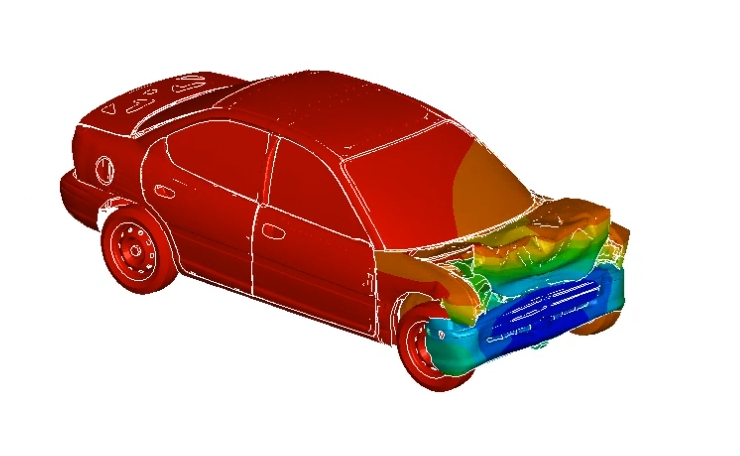
Necessity of Crash Analysis
-
Ensuring Safety
-
Minimizing Human Casualties: For products and structures directly related to human life—such as automobiles, aircraft, buildings, and protective equipment—minimizing injury during impact is of utmost importance. Crash analysis enables prediction of energy absorption capacity, deformation patterns, and failure mechanisms to ensure occupant or user safety.
-
Compliance with Regulations: Strict safety standards and regulations exist across industries (e.g., automotive crash safety standards, seismic design codes for buildings, aircraft crashworthiness criteria). Crash analysis provides essential verification data to meet these regulations and obtain necessary certifications.
-
-
Design Optimization & Cost Reduction
-
Efficient Iterative Design: Conducting physical crash tests for each design change is time-consuming and expensive. Simulation-based crash analysis allows immediate evaluation of multiple design iterations, supporting rapid and efficient optimization.
-
Shorter Product Development Time: By addressing crash safety in the early design stages without the need for physical testing, the overall development process is accelerated, allowing faster time-to-market.
-
Weak Point Identification and Reinforcement: Simulations help detect vulnerable areas in a structure during impact, enabling targeted reinforcement to improve durability and overall performance.
-
-
Material and Structural Behavior Analysis
-
Understanding Dynamic Material Behavior: Crash analysis enables detailed evaluation of how materials deform and fail under high-speed impacts, and how energy is absorbed. This contributes to the development of new materials or broader application of existing ones.
-
Solving Complex Nonlinear Problems: Crash scenarios involve large deformations, complex contact interactions, nonlinear material behavior, and fracturing. Crash analysis tools are capable of solving these challenging nonlinear problems effectively.
-
Effects of Crash Analysis
-
Improved Product Reliability and Competitiveness
-
Products with verified crash performance gain consumer trust and increase market competitiveness.
-
Superior safety performance enhances brand value and corporate image.
-
-
Cost Savings and Enhanced Efficiency
-
Reduced number of physical prototypes leads to direct savings in material, labor, and equipment costs.
-
Early detection and correction of design errors lowers rework time and expenses.
-
Increased efficiency in the development process minimizes waste and boosts productivity.
-
-
Accident Investigation and Prevention
-
Crash analysis can be used to determine the causes of real-life accidents and develop preventative strategies to avoid recurrence (e.g., analyzing vehicle crash patterns to suggest safety improvements).
-
It enables early identification of potential risks, allowing proactive mitigation.
-
-
Driving Technological Advancement and Innovation
-
The advancement of crash analysis technology supports the development of new design methodologies, adoption of lightweight high-strength materials, and ultimately, the creation of safer and more innovative products.
-
It is particularly essential for future technologies such as eco-friendly and autonomous vehicles, and advanced aerospace systems.
-